dghdfgdfg

dghdfgdfg
Authored by
Amar Workshop
Date Released
29 June, 2026
Modern vehicles are equipped with sophisticated electronic systems designed to improve performance, safety, fuel efficiency, and driving comfort. Unlike older vehicles that relied mainly on mechanical components, today's cars use multiple computers, sensors, and electronic control units (ECUs) to monitor nearly every aspect of vehicle operation.
When something goes wrong, these systems record fault codes and often alert the driver through dashboard warning lights. Identifying the exact cause without specialized equipment can be difficult. That's where computerized engine diagnostics become essential.
At Amar Workshop, we use advanced diagnostic scanners and manufacturer-level diagnostic tools to accurately identify problems, helping customers avoid unnecessary repairs while restoring their vehicles to peak performance.
What Is Engine Diagnostics?
Engine diagnostics is the process of electronically scanning your vehicle's computer systems to identify faults affecting engine performance and other critical components.
Modern vehicles continuously monitor systems such as:
Engine
Transmission
Fuel injection
Ignition system
ABS braking
Airbags
Steering
Suspension
Air conditioning
Emission control
Battery charging system
Electronic stability control
Whenever the system detects an abnormal condition, it stores a Diagnostic Trouble Code (DTC) inside the vehicle's ECU.
These codes help technicians determine the source of the problem quickly and accurately.
What Is an ECU?
The Electronic Control Unit (ECU) is often called the "brain" of your vehicle.
It receives information from dozens of sensors installed throughout the vehicle and continuously adjusts:
Fuel delivery
Ignition timing
Air-fuel mixture
Engine temperature
Transmission shifting
Idle speed
Emission control
Turbocharger operation (if equipped)
The ECU performs thousands of calculations every second to keep the vehicle operating efficiently.
What Is OBD-II?
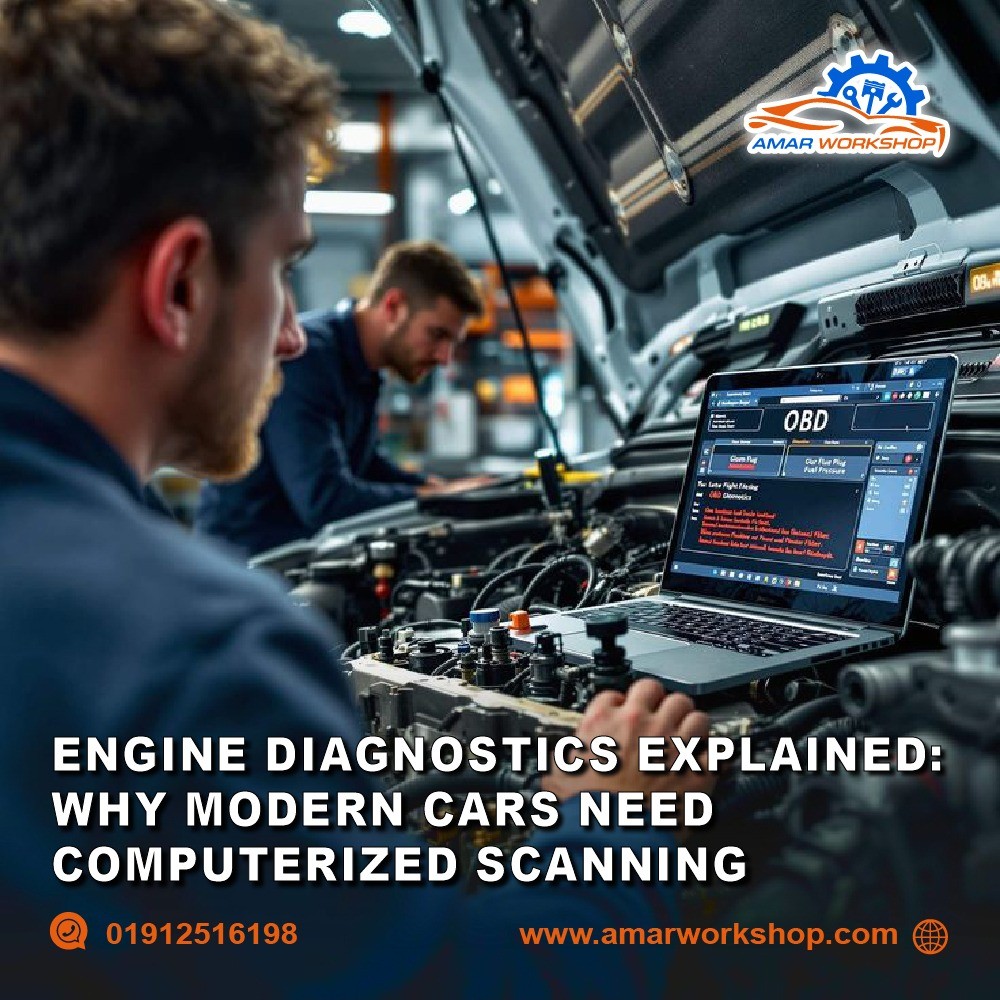
OBD-II (On-Board Diagnostics II) is the standardized diagnostic system used in most modern vehicles.
Through the OBD-II port, technicians connect specialized diagnostic equipment that communicates directly with the vehicle's ECU.
The scanner retrieves:
Diagnostic Trouble Codes (DTCs)
Live engine data
Sensor readings
System performance information
Pending faults
Historical fault records
Emission system status
This information significantly reduces guesswork during repairs.
How Does Computerized Vehicle Diagnostics Work?
At Amar Workshop, our diagnostic process follows a systematic approach:
Step 1: Customer Consultation
Our technicians begin by discussing the symptoms you have noticed, such as:
Engine warning light
Poor acceleration
Rough idling
Starting problems
Increased fuel consumption
Strange noises
Reduced performance
Understanding these symptoms helps guide the diagnostic process.
Step 2: Vehicle Inspection
Before connecting diagnostic equipment, we perform a visual inspection to identify obvious issues such as:
Loose wiring
Fluid leaks
Damaged hoses
Worn belts
Battery condition
Sometimes a simple visual inspection reveals the source of the problem.
Step 3: Computerized Scanning
We connect professional diagnostic equipment to your vehicle's OBD-II port.
The scanner retrieves:
Stored fault codes
Pending fault codes
Live sensor data
Freeze-frame data
ECU communication status
Our technicians then analyze this information to pinpoint the underlying issue.
Step 4: Technical Diagnosis
Fault codes do not always identify the defective component directly.
For example:
A Check Engine Light may indicate:
Oxygen sensor failure
Fuel injector malfunction
Ignition coil problem
Air intake leak
Catalytic converter issue
Our experienced technicians combine scan results with mechanical testing to ensure an accurate diagnosis.
Step 5: Repair Recommendations
After identifying the issue, we provide:
A clear explanation of the problem
Recommended repairs
Estimated repair costs
Expected completion time
We believe in transparent communication so customers can make informed decisions.
Step 6: Repair and Verification
Once repairs are completed, we perform another diagnostic scan to confirm:
Fault codes have been cleared
All systems are operating correctly
No additional issues remain
Finally, we conduct a road test to verify vehicle performance.
Common Problems Computerized Diagnostics Can Detect
Modern diagnostic equipment can identify a wide range of issues, including:
Engine Problems
Misfires
Overheating
Low compression
Fuel delivery issues
Air intake leaks
Fuel System Issues
Clogged fuel injectors
Weak fuel pump
Fuel pressure problems
Ignition System Problems
Faulty spark plugs
Ignition coil failures
Timing issues
Transmission Faults
Gear shifting problems
Solenoid failures
Transmission sensor faults
Electrical Problems
Battery charging issues
Alternator faults
Wiring problems
Sensor failures
Emission System Issues
Catalytic converter problems
Oxygen sensor failures
EVAP system leaks
EGR valve issues
Cooling System Problems
Thermostat failure
Cooling fan malfunction
Coolant temperature sensor issues
Signs Your Vehicle Needs a Diagnostic Scan
You should schedule diagnostics immediately if you notice:
Check Engine Light
ABS warning light
Airbag warning light
Poor fuel economy
Rough engine idle
Engine hesitation
Difficulty starting
Loss of power
Transmission shifting issues
Increased exhaust smoke
Strange engine noises
Ignoring these warning signs can result in more expensive repairs later.
Benefits of Computerized Diagnostics
Accurate Problem Identification
Modern scanners quickly identify hidden issues that are impossible to detect through visual inspection alone.
Faster Repairs
Accurate diagnosis reduces repair time because technicians know exactly where to begin.
Lower Repair Costs
Early detection prevents small issues from developing into major mechanical failures.
Improved Fuel Efficiency
Identifying faulty sensors and engine problems helps restore optimal fuel consumption.
Enhanced Vehicle Safety
Diagnostics identify faults affecting:
Brakes
Steering
Airbags
Electronic stability control
Traction control
Better Engine Performance
A properly functioning engine delivers:
Smoother acceleration
Improved power
Better fuel economy
Lower emissions
Can You Ignore the Check Engine Light?
Many drivers continue driving after the Check Engine Light appears.
This is a costly mistake.
A flashing Check Engine Light often indicates severe engine misfires that can damage the catalytic converter.
Even a steady warning light should be diagnosed as soon as possible.
Ignoring warning lights can lead to:
Engine damage
Transmission failure
Higher fuel costs
Increased emissions
Expensive repairs
Why Choose Amar Workshop for Engine Diagnostics?
At Amar Workshop, we combine advanced technology with experienced technicians to provide reliable and accurate vehicle diagnostics.
Our Diagnostic Services Include:
Computerized Vehicle Diagnostics
Engine Performance Analysis
ECU Fault Code Reading
Live Data Monitoring
Sensor Testing
Fuel System Diagnostics
Ignition System Testing
Battery & Charging System Analysis
Transmission Diagnostics
Hybrid & Electric Vehicle Diagnostics
Our goal is to identify problems quickly, explain them clearly, and repair them correctly the first time.
Frequently Asked Questions (FAQs)
1. What is a computerized diagnostic scan?
A computerized diagnostic scan connects to your vehicle's ECU to read fault codes, monitor system performance, and identify mechanical or electronic issues.
2. Can diagnostics find every vehicle problem?
Diagnostics are highly effective for electronic and sensor-related faults. However, technicians also perform visual inspections and mechanical testing to diagnose issues that may not generate fault codes.
3. How long does a diagnostic scan take?
A standard diagnostic scan usually takes 30–60 minutes, depending on the complexity of the issue and the systems being evaluated.
4. Should I drive with the Check Engine Light on?
If the light is steady, you should have it checked as soon as possible. If it is flashing, stop driving immediately and seek professional assistance, as this may indicate a serious engine problem.
5. Does Amar Workshop provide diagnostics for all vehicle brands?
Yes. Amar Workshop offers computerized diagnostics for most passenger vehicles, SUVs, commercial vehicles, hybrid vehicles, and electric vehicles using advanced diagnostic equipment.
Conclusion
Computerized engine diagnostics have transformed modern vehicle maintenance by making it faster, more accurate, and more cost-effective. Instead of relying on guesswork, technicians can identify problems precisely, reducing repair time and helping prevent unnecessary expenses.
Whether your Check Engine Light is on or your vehicle isn't performing as it should, early diagnosis can save you time, money, and stress.
Book Your Engine Diagnostic Service at Amar Workshop
At Amar Workshop, we provide professional computerized diagnostics, expert repairs, and comprehensive maintenance services to keep your vehicle running safely and efficiently. Our experienced technicians use advanced diagnostic tools to identify issues accurately and deliver dependable solutions you can trust.
Contact Amar Workshop today and let our experts keep your vehicle performing at its best.